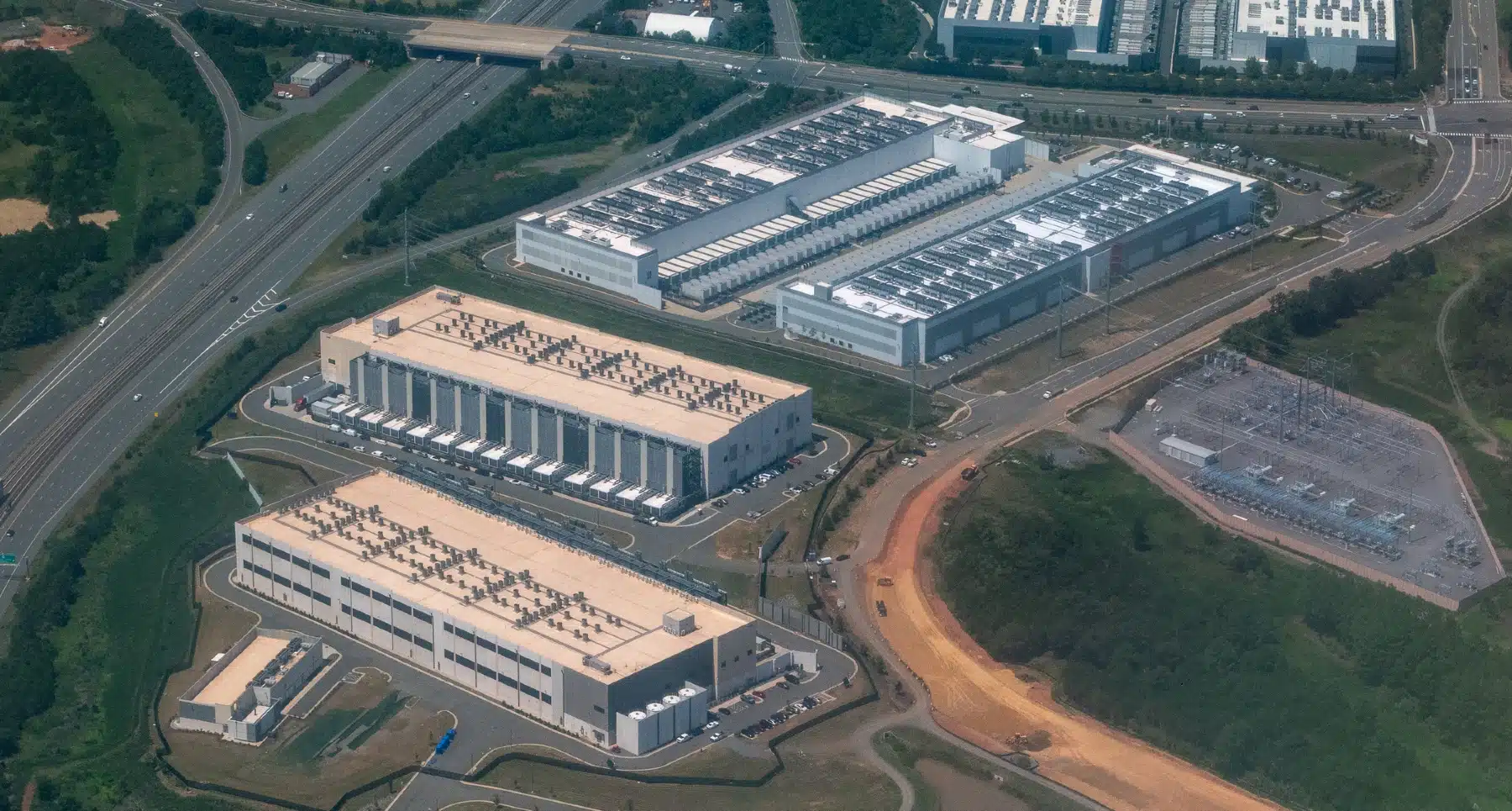
Harvard researchers have mapped 403 of America’s largest data centres and traced the power they draw. More than half came from gas and coal, as operators’ clean power deals struggle to keep pace with demand.
Some 403 of America’s largest data centres used 68 to 99 terawatt-hours (TWh) of electricity in a year. About 54% of it came from fossil fuels. That’s the finding of a Harvard study in Nature Sustainability, which covers May 2024 to April 2025. The team found the sites using satellite images and permit records. It then matched each one to the grid that supplies it.
Gas supplied 38% of that power and coal 15%. In total, the researchers put the sites’ emissions at about 25.7m tonnes of CO2, two to three times an earlier estimate for 2018. The study found that’s more carbon dioxide than Denmark emits in a year.
At 82 TWh, within the study’s range, that’s enough to power nearly 7 million American homes for a year. The study’s central estimate is about 1.8% of US electricity, used by a few hundred buildings.
US data centre demand has tripled since 2014
The national total is far larger. US data centres of every size used 58 TWh in 2014 and 176 TWh in 2023, Lawrence Berkeley National Laboratory found. That was 4.4% of national demand. Its report for the Department of Energy projects a share of 6.7% to 12% by 2028. However, the two studies use different years, methods and sets of sites, so their totals don’t compare directly.
Electricity use at the biggest tech companies rose 240% between 2022 and 2025. Developers also plan about 2,000 more data centres. So the Harvard team expects demand and emissions to be higher now, because construction has continued.
Virginia, Oregon, Ohio and Iowa account for more than half of the electricity in the study. About a quarter of the power came from grid regions dirtier than the US average.
Clean power deals are growing more slowly than demand
To clean up that mix, Meta, Amazon, Google and Microsoft signed 49% of the world’s corporate clean energy deals in 2025, BloombergNEF found. Meta and Amazon alone contracted 20.4 gigawatts (GW), including 4.7 GW of nuclear.
Google signed agreements for more than 12 GW of new clean energy in 2025, the most in its history. Only about 2 GW of projects came online that year, while its electricity use rose 37%. Google still matched its annual electricity use with renewable purchases. However, its latest environmental report says “reaching our climate moonshot is getting harder”.
Google’s nuclear deals take longer to deliver. Its agreement with Kairos Power and the Tennessee Valley Authority would deliver 50 megawatts from a small modular reactor in Oak Ridge, Tennessee, from 2030. That’s the first step in a plan for up to 500 megawatts. A restart of the Duane Arnold plant in Iowa should add 600 megawatts for Google from early 2029. Tech firms plan to finance more than 20 GW of small reactors, but the IEA expects the first US units only after 2030.
The IEA expects gas to be the largest source of new US supply for data centres. It projects gas adding more than 130 TWh of US data centre supply by 2030, against 110 TWh from renewables. In March, Meta agreed to pay for seven new gas plants for its most power-hungry data centre, in rural Louisiana. They would supply 5.2 GW, and bring the number of gas plants planned for the site to ten.
Outside researchers are filling a disclosure gap
Companies don’t openly share power and pollution data for their sites, so the Harvard team built its own estimates. For that reason, outside experts told the Associated Press the modelling was reasonable. “We cannot manage environmental impacts effectively without reliable measurements and disclosure,” said Fengqi You of Cornell University, who wasn’t involved in the study.
Governments have started to ask for that disclosure. On 16 November, the COP31 presidency and the International Telecommunication Union launched the Antalya AI Pledge at the climate talks in Türkiye. Endorsers commit to low- and zero-emission power for data centres. They also commit to support reporting of AI’s environmental impact with standard methods. The COP will track progress each year until 2030. Meanwhile, the EU has adopted a rating scheme that will label every data centre with 500kW or more of IT power by August 2027.
The researchers couldn’t separate AI workloads from general computing, and they lacked data for some hyperscale sites. They also didn’t measure health effects, which they plan to study next.
Grid connection queues in Texas and the UK already exceed each system’s peak demand, with data centres behind much of the backlog. So the next figure to watch is the share of new data centre load that runs on low-carbon power. The second is how fast signed contracts become working projects. Reporting under the Antalya pledge would give the first common measure of both, if the big operators sign up. Until then, outside estimates such as Harvard’s remain the main check on the industry’s emissions.
Subscribe
Sign-up to receive our newsletter