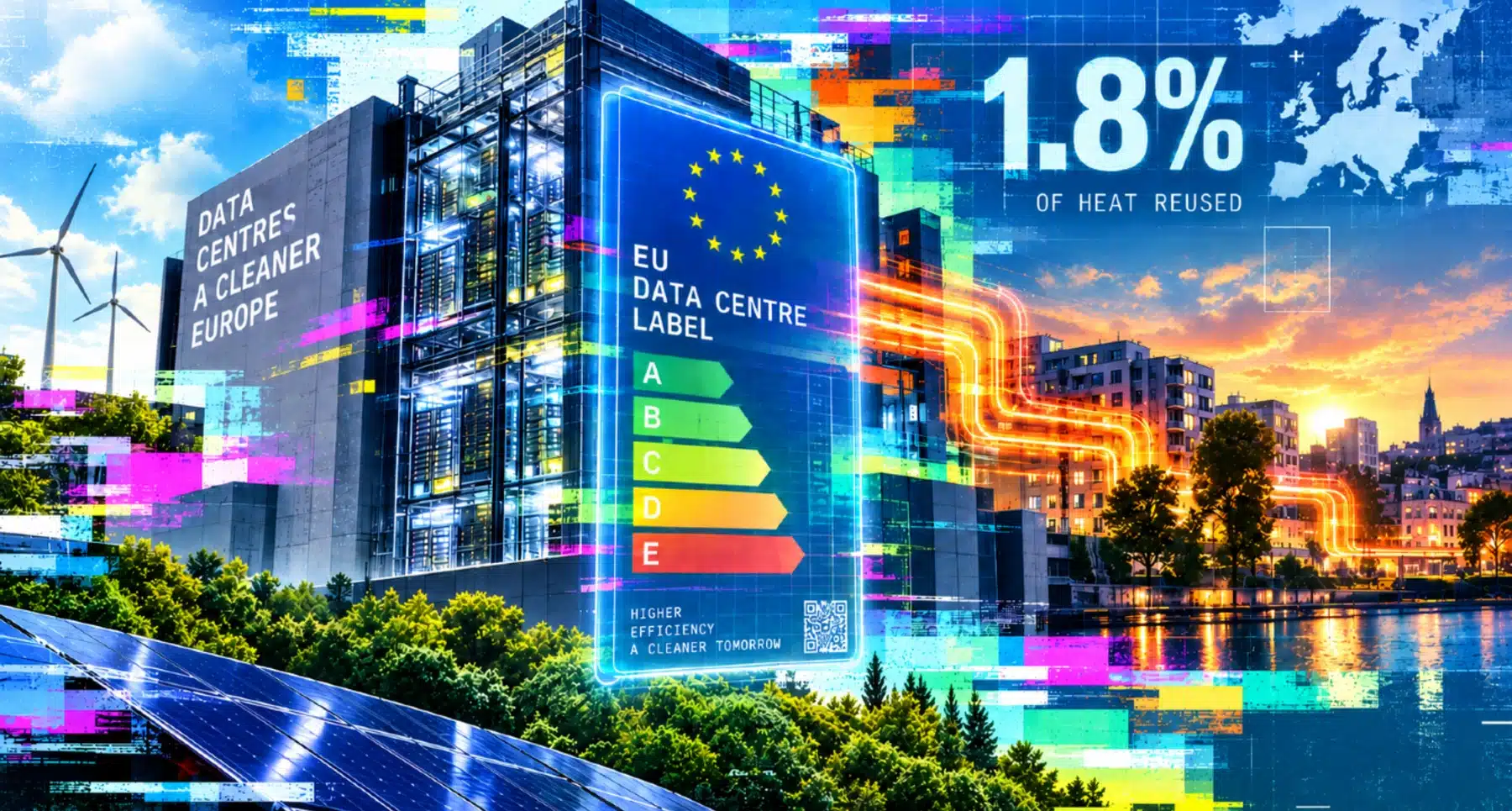
The European Commission has adopted a rating scheme for EU data centres. Every site above 500kW will carry a label, and the first reported figures show a sector reusing 1.8% of its heat.
The Commission adopted a delegated regulation on 21 September creating a common rating scheme for EU data centres. It covers every site with 500kW or more of installed IT power. The European database will generate a label for each one by 15 August 2027, then annually. Parliament and the Council have two months to object.
The baseline arrived with it. 770 data centres filed data in the first reporting round, which ran from May to September 2024. That is about 36% of the estimated EU total. Their average power usage effectiveness was 1.36 and their average water usage effectiveness 0.58. Renewable sources covered 86% of their electricity, on a weighted average. About 1.8% of the heat they generated was reused.
That last figure is the one the label will expose. EU data centres used 68 TWh of electricity in 2024, and the Commission expects 114 TWh by 2030. That would be above 3% of EU demand. The Commission also wants to triple the bloc’s data centre capacity within five to seven years. “Tripling our data centre capacity cannot mean tripling the pressure on our grids, our water and our energy bills,” said Teresa Ribera. She is the Commission’s Executive Vice-President for Clean, Just and Competitive Transition.
Almost none of the heat is reused
Reusing about half of Europe’s data centre waste heat would cover the heating demand of 4 million households, on the Commission’s own estimate. The reported rate is 1.8%.
The label is the only part of a site’s data that becomes public. Everything else stays confidential, which is the scheme’s weak point. Confidentiality clauses will let a company “consume an undisclosed gigawatt of power”, argues Bram Vranken, a researcher at Corporate Europe Observatory.
Communities are already asking what the label will answer. About 400 people protested in Linz on 22 September. Their target is a Google data centre under construction at Kronstorf, a town of 3,500 people. Its first phase could draw 1.31 TWh a year, roughly what 375,000 households use. “Everything is extremely non-transparent, nobody knows anything,” said Andrea Kollmann, a lawyer who travelled from Vienna.
The hardware really is getting better
Per unit of work, the industry’s record is good. Leading machine learning chips improve their energy efficiency by about 40% a year, on Epoch AI’s tracking. Peak performance per watt doubles roughly every two years. Nvidia says its Blackwell generation delivers 10 times the throughput per megawatt of its predecessor on mixture-of-experts models, using benchmarks run by SemiAnalysis.
Buildings improved too, then stopped. Global average power usage effectiveness fell from 1.98 in 2007 to 1.52 this year. The Uptime Institute found that in its 2026 survey of more than 800 operators. The figure has sat between 1.52 and 1.58 since 2019, which the institute calls seven years of relative stasis. Europe’s reported 1.36 sits below the global number. Operators report it themselves, and the Commission deems 70.1% of the returns reliable.
Volume is the number that moves
Those gains have not slowed the total. Global data centre electricity use rose 17% in 2025 while total electricity demand rose 3%. The International Energy Agency expects data centre consumption to double by 2030, and AI-focused consumption to triple. Power per AI task, it notes, is falling at a rate unprecedented in energy history.
Nvidia’s scope 3 emissions reached 10.7 million tonnes of CO2 equivalent in its 2026 financial year. Two years earlier they stood at 3.6 million tonnes, on Greenpeace East Asia’s reading of the company’s own report. Campaign research published on 16 September puts the company’s indirect emissions up 725% since 2020. Stand.earth, Greenpeace International and six other groups wrote it. They estimate that chips already sold produced up to 21 million tonnes of CO2 equivalent in 2025. Data centres now supply 92.5% of its revenue.
A 2026 chip does far more work per watt than a 2020 chip, and Europe’s fleet keeps getting larger. The label will show whether there is any positive change to the 1.8% figure. Consultation on minimum standards closes on 14 December, and the first review is due by the end of 2028.
Subscribe
Sign-up to receive our newsletter