Finland tops a new index of happiness, freedom and passport power. The average passport opens almost twice as many borders as in 2006, while routes to settle abroad narrow.
Finland has topped the Happy Passports Index 2026 with 93.2 points, ahead of Iceland on 92.4 and Denmark on 92.1. The index comes from Global Citizen Solutions, a firm that advises wealthy families on residency and citizenship. It ranks 50 countries on four equal pillars: wellbeing, freedom at home, passport strength, and prosperity, health and safety.
Nordic countries hold the top four places, with Norway fourth and Sweden sixth. Spain, Italy, Greece and Portugal all hold passports among the ten strongest in the sample, matching Nordic passport power. Yet none of them makes the top 15. Greece has the ninth strongest passport but ranks 43rd of 50 on wellbeing and 36th overall.
In the richer half of the sample, the firm finds that life ratings track freedom of choice far more closely than passport strength or income. The rank correlations are 0.79, 0.28 and 0.29. “Among wealthier countries, our briefing finds that happiness correlates far more strongly with freedom than with passport strength,” said Dr Laura Madrid, lead researcher at Global Citizen Solutions.
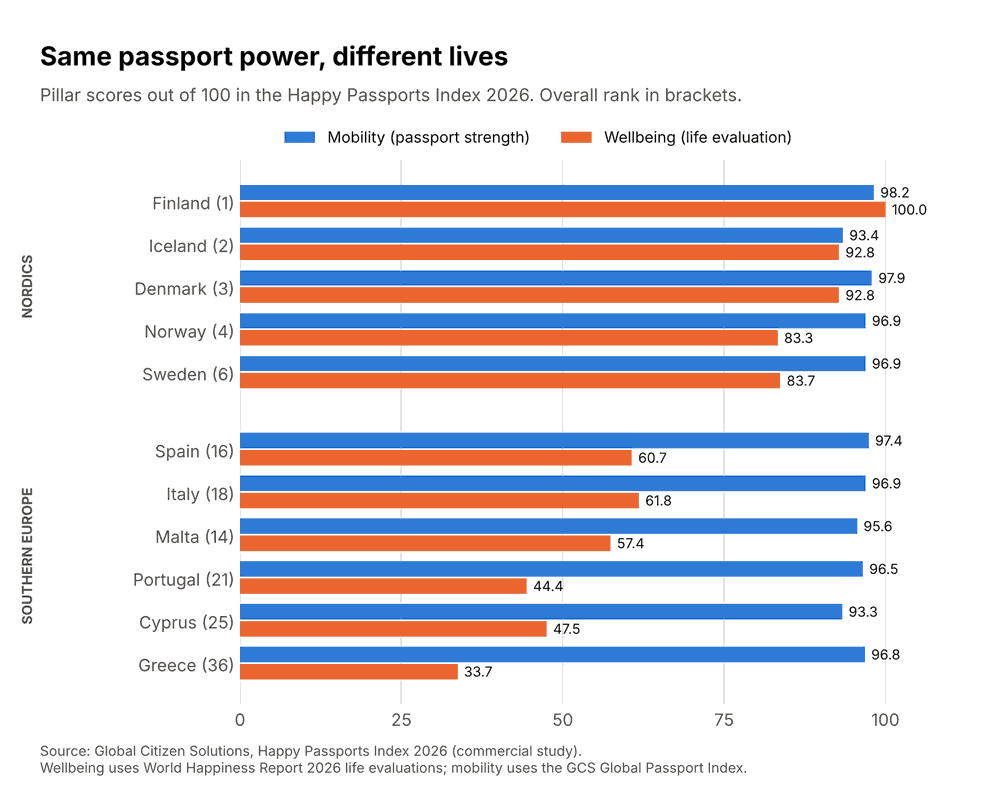
Ten of the 12 Latin American countries in the sample rate their lives above what their income would predict. Costa Rica ranks 13th overall, ahead of Canada and Spain, despite a much weaker passport. Its residents rate their lives 1.2 points higher than its income predicts, on a scale of 0 to 10. No country in the sample beats that margin.
More passports open more doors
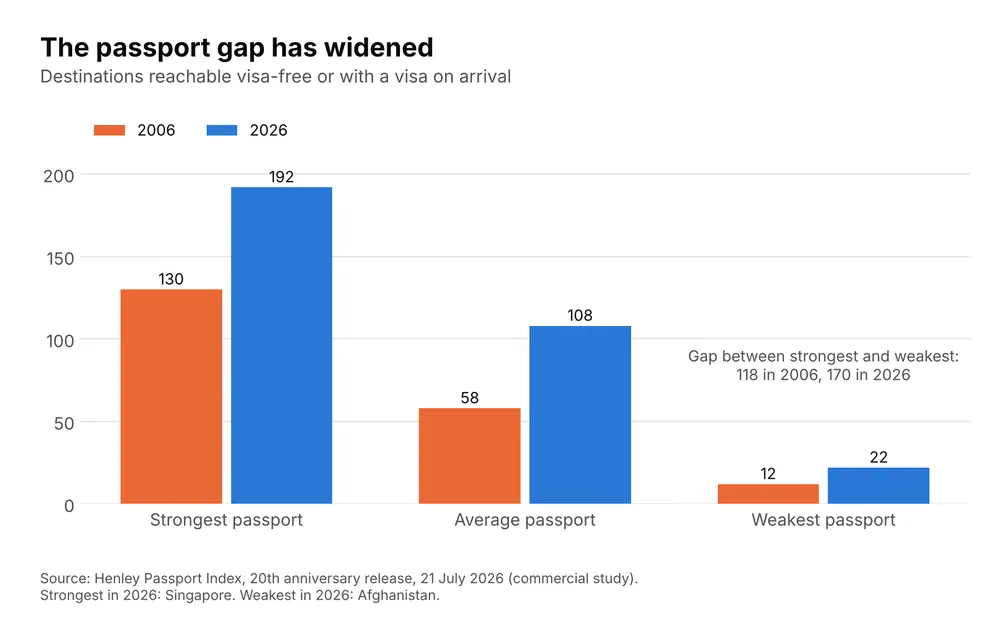
The index scores mobility with the firm’s own Global Passport Index. That score measures the option to travel, and it says nothing about how often people use it. On that measure, travel has opened up over two decades. The average passport now gives visa-free or visa-on-arrival access to 108 destinations, up from 58 in 2006. That figure comes from the Henley Passport Index, run by Henley & Partners, another residency and citizenship firm.
Singapore’s passport now reaches 192 destinations, against 130 for the leaders in 2006. Afghanistan’s reaches 22, up from 12. As a result, the gap between top and bottom has widened from 118 destinations to a record 170. The Happy Passports Index scales each measure from the lowest country to the highest. On mobility, Vietnam scores zero and Kenya scores eight.
A right to leave, with no right to enter
Article 13 of the Universal Declaration of Human Rights gives everyone the right to leave any country, including their own. It gives no matching right to enter another. Across the richer world, governments are tightening exactly that second step.
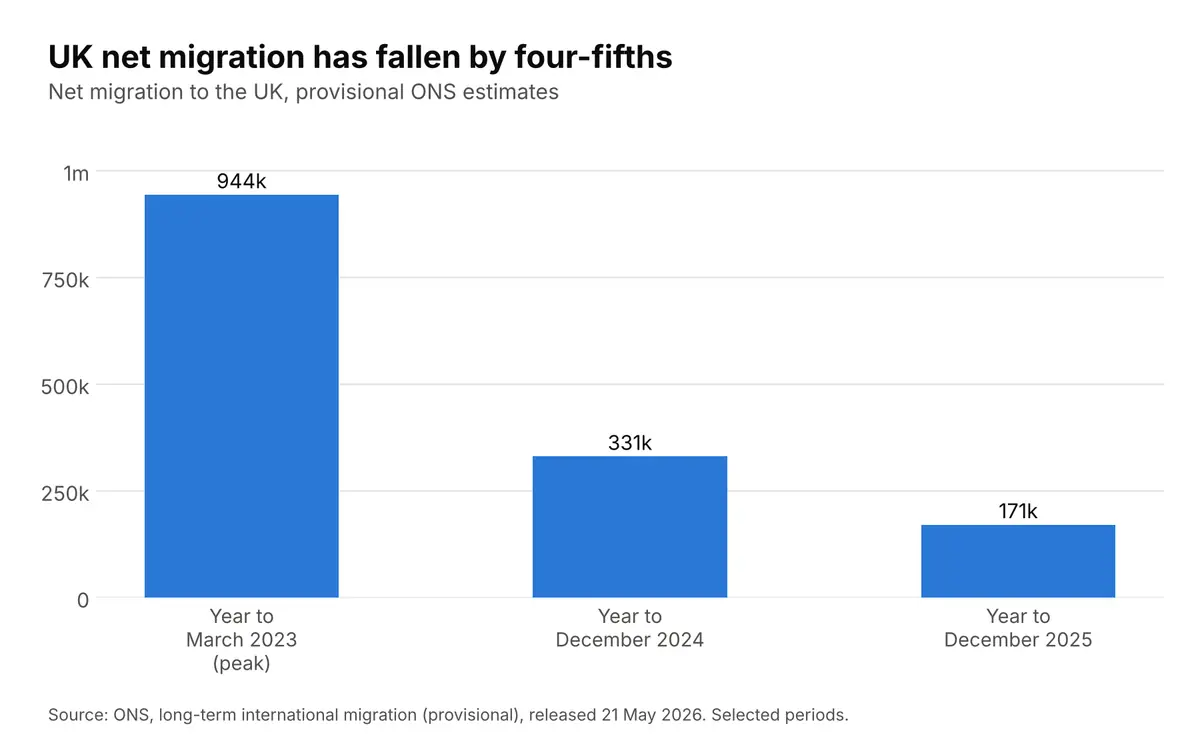
In the UK, net migration fell to 171,000 in the year to December 2025. It had peaked at 944,000 in the year to March 2023. About 813,000 people arrived in 2025 and 642,000 left.
In the US, economists at Brookings and the American Enterprise Institute estimate net migration at between minus 295,000 and minus 10,000 in 2025. That would probably make it the first negative year in at least half a century. They expect a figure between minus 925,000 and plus 185,000 in 2026.
The EU’s Pact on Migration and Asylum took effect on 12 June. It requires screening of every irregular arrival within seven days at the external border. Applicants unlikely to qualify for protection now face border procedures. EU+ countries received about 822,000 asylum applications in 2025, down 19% on 2024 and almost a third below 2023. In France, Marine Le Pen, whose party has long campaigned for lower immigration, leads the polls for 2027.
In April 2025, the EU’s top court ruled Malta’s investor citizenship scheme unlawful. It found that selling nationality is incompatible with EU citizenship. That same month, Spain stopped issuing golden visas to property investors. Both schemes gave residence or citizenship in return for investment, so even routes for the wealthy have narrowed.
Fewer people want to move
In Gallup’s World Poll, 15% of adults said in 2025 that they would move abroad for good if they could. That was down from 16% in each year from 2021 to 2024, and the lowest share since 2018. It still adds up to about 900 million people.
Only 15% of these would-be migrants named the US as their first choice, the lowest share in nearly two decades of Gallup’s polling. Canada drew 9%. Among some Americans, though, the wish to leave has grown. Among American women aged 15 to 44, 40% say they would move abroad for good if they could, up from 10% in 2014.
The US passport ranked first on the Henley index in 2006 and tenth in July 2026. Its holders still need a visa for China, while British and Canadian travellers have gained visa-free entry. In the Happy Passports Index, the US ranks 28th overall and 47th of 50 on freedom of choice.
What a strong passport buys
Denmark is the only country in the index to rank in the top four on all four pillars. Its residents pair a strong passport with high ratings for life and for freedom at home. Global Citizen Solutions argues that a passport offers “choice beyond the border”. The figures above suggest that choice is widening for short visits and narrowing for people who want to settle.
The OECD publishes its International Migration Outlook 2026 on 12 November. It will show whether new permanent migration to OECD countries fell again. In 2024 it dropped by 4%, after three years of rises.
Subscribe
Sign-up to receive our newsletter