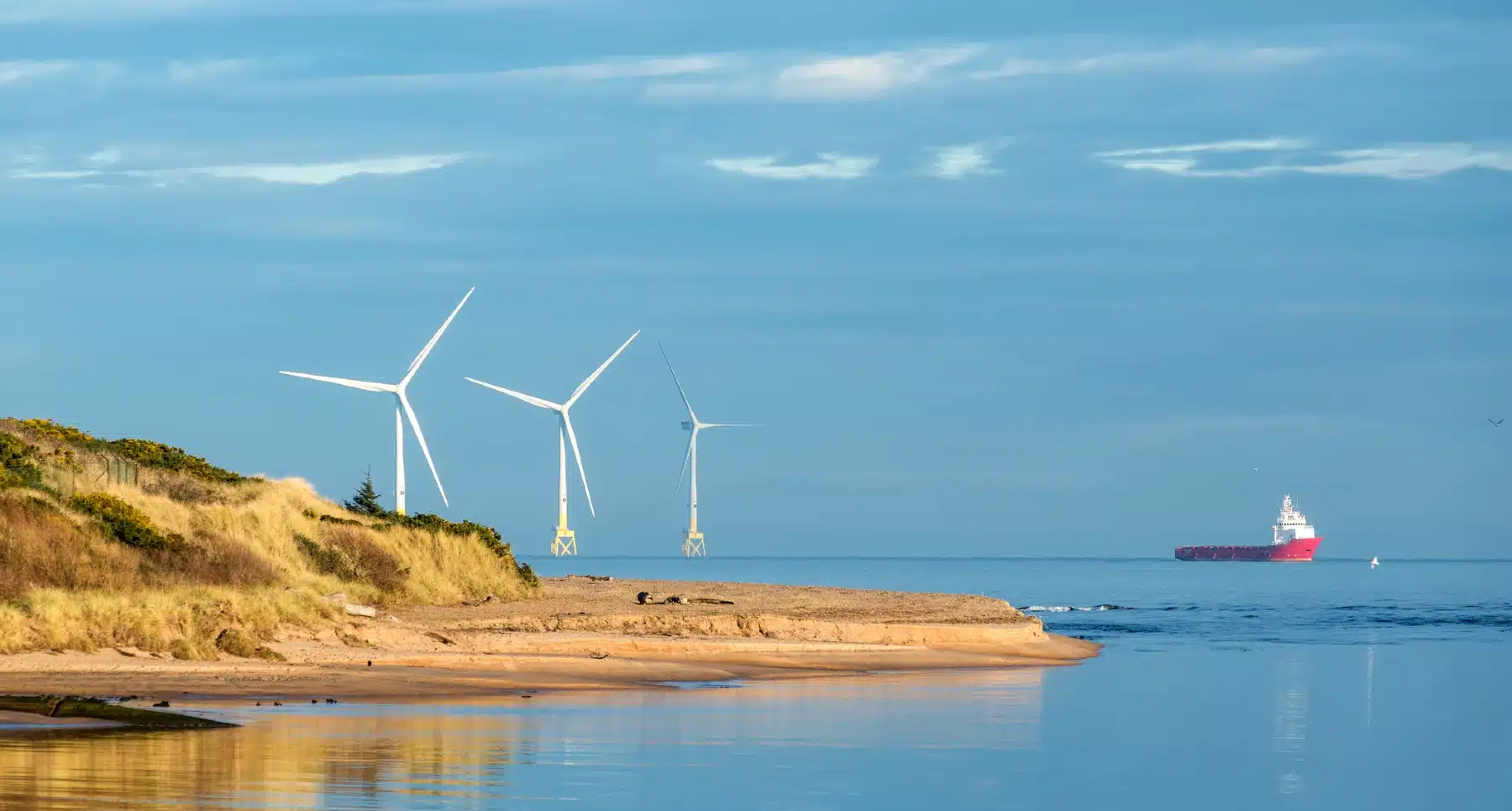
Wind and solar have spared the UK an estimated £5.9bn of gas imports since the Iran war began. Donald Trump, the Conservatives and Reform UK want more North Sea drilling, but the evidence on bills and security favours building clean power.
Wind and solar output has avoided £5.9bn of UK gas imports since the US-Israeli war on Iran began in late February. That’s the finding of analysis by Carbon Brief, published on 30 September. September to date accounted for £1.3bn. Over the whole period, the avoided gas equals more than 100 tanker deliveries of liquefied natural gas (LNG).
UK wholesale gas averaged 134p a therm after the war began, against about 90p between 2023 and early 2026. On 8 September it closed at 188p, above the December 2022 peak. Carbon Brief counts every unit of wind and solar as gas that would otherwise have been burned, so its figure is gross. Ember applied a narrower test, counting only capacity built since 2021 and deducting subsidy payments. It still found savings of about £7m a day in the war’s first month.
Since the war began, Trump, Kemi Badenoch and Reform UK have pressed for a different answer: more oil and gas from the North Sea. Ministers face a choice between producing more fossil fuel at home and needing less of it.
The case for drilling
On 14 April Trump turned to Truth Social. “U.K., which is better situated on the North Sea for purposes of energy than Norway, should, DRILL, BABY, DRILL!!!” he wrote. “AND, NO MORE WINDMILLS!”
Badenoch’s Conservatives would scrap the ban on new North Sea licences and the windfall tax on oil and gas profits. Reform UK would also put drilling first. “If you are anti-energy, you are anti-growth by definition,” Richard Tice, Reform’s deputy leader, told industry figures in May.
Offshore Energies UK (OEUK), the industry body, puts the security case in numbers. With tax reform, imported LNG would supply 6% of UK gas by 2035, it says. Without reform, the share would reach 46%. “The UK will still need oil and gas for decades to come,” said David Whitehouse, OEUK’s chief executive.
Andy Burnham hasn’t reversed Labour’s licence ban, though ministers have backed tiebacks to existing fields. “Bills are not high because of net zero,” Miatta Fahnbulleh, the energy secretary, told Labour’s conference on 28 September. “They are high because Britain has left itself exposed.” A day later the prime minister promised to “be pragmatic in relation to the North Sea”.
What more drilling would change
Domestic production met about half of UK gas demand in 2025, and output is declining, the North Sea Transition Authority says. Whatever the UK produces, it sells at international prices. “We are price-takers, not price-makers,” a government factsheet said in March. New licences “wouldn’t make any difference to the prices set by international markets”, it added.
On 30 March Badenoch accepted the point herself. “The drilling isn’t going to go directly onto people’s bills,” she said. Her argument is that tax revenue from new production could fund lower bills.
Oxford’s Smith School has modelled that route. Maximising North Sea output would save households £16 to £82 a year, and only if the tax went back into bills, its study found. A fully renewable system would save up to £441. The modelling used January 2026 prices, before the war. Dr Anupama Sen, the school’s head of policy engagement, called the security and savings claims for drilling “sheer fantasy”.
Globally, it has taken almost 20 years on average to move from an exploration licence to first production. That figure comes from the International Energy Agency (IEA). Jobs haven’t tracked output either. North Sea production rose by a fifth between 2014 and 2019, while oil and gas employment in Aberdeen fell 11%, the Resolution Foundation found.
Italy drills, Spain builds
Italy’s cabinet moved in September to speed up drilling permits. “It makes little sense to buy this energy from abroad when we can also produce it here in Italy,” Giorgia Meloni said. Italy still expects an energy import bill of nearly €60bn this year.
In March, Italian wholesale power averaged €143/MWh, Ember calculates. Spain, which leans on wind and solar, paid €42/MWh. Gas set or influenced Spanish power prices in 9% of hours from January to May, against 75% in Italy.
Pakistan’s panel imports grew from under 1GW in 2018 to more than 51GW. That solar had avoided over $12bn of oil and gas imports by February, a joint study found. Across all importing countries, clean power added since 2020 saved about $36bn in fuel imports from March to July. The Centre for Research on Energy and Clean Air (CREA) made that estimate. The same disruption has pushed global fossil fuel emissions towards a fall this year.
Build times and import bills
New solar won contracts in the latest UK auction at £65.23/MWh, and onshore wind at £72.24/MWh. Both are “under half the £147/MWh cost of building and operating new gas power stations”, energy minister Michael Shanks told Parliament.
In April the IMF urged governments to “accelerate adoption of renewable energy to strengthen resilience to energy shocks”. Faster electrification could cut fuel importers’ bills by more than $400bn by 2035 on 2025 levels, the IEA calculated last month. The European Commission expects its electrification plan to cut EU fossil imports by €260bn a year by 2040.
The same IEA report names new risks, including concentrated supply chains for critical minerals and grids exposed to extreme weather. Fatih Birol, the IEA’s executive director, has also warned about timing. Renewables “will not be a solution to the current crisis”, he said in April. Gas still sets the UK power price in most hours, so “electricity prices still follow gas prices upwards”, the UK Energy Research Centre noted.
On the evidence since February, new wind, solar and electrification cut import bills faster and for longer than new licences can. Burnham says he has asked Fahnbulleh to speed up “the breaking of the link” between UK power prices and the international gas market. Ofgem’s price cap for January to March will show how much of the £5.9bn reaches households this winter.
Subscribe
Sign-up to receive our newsletter