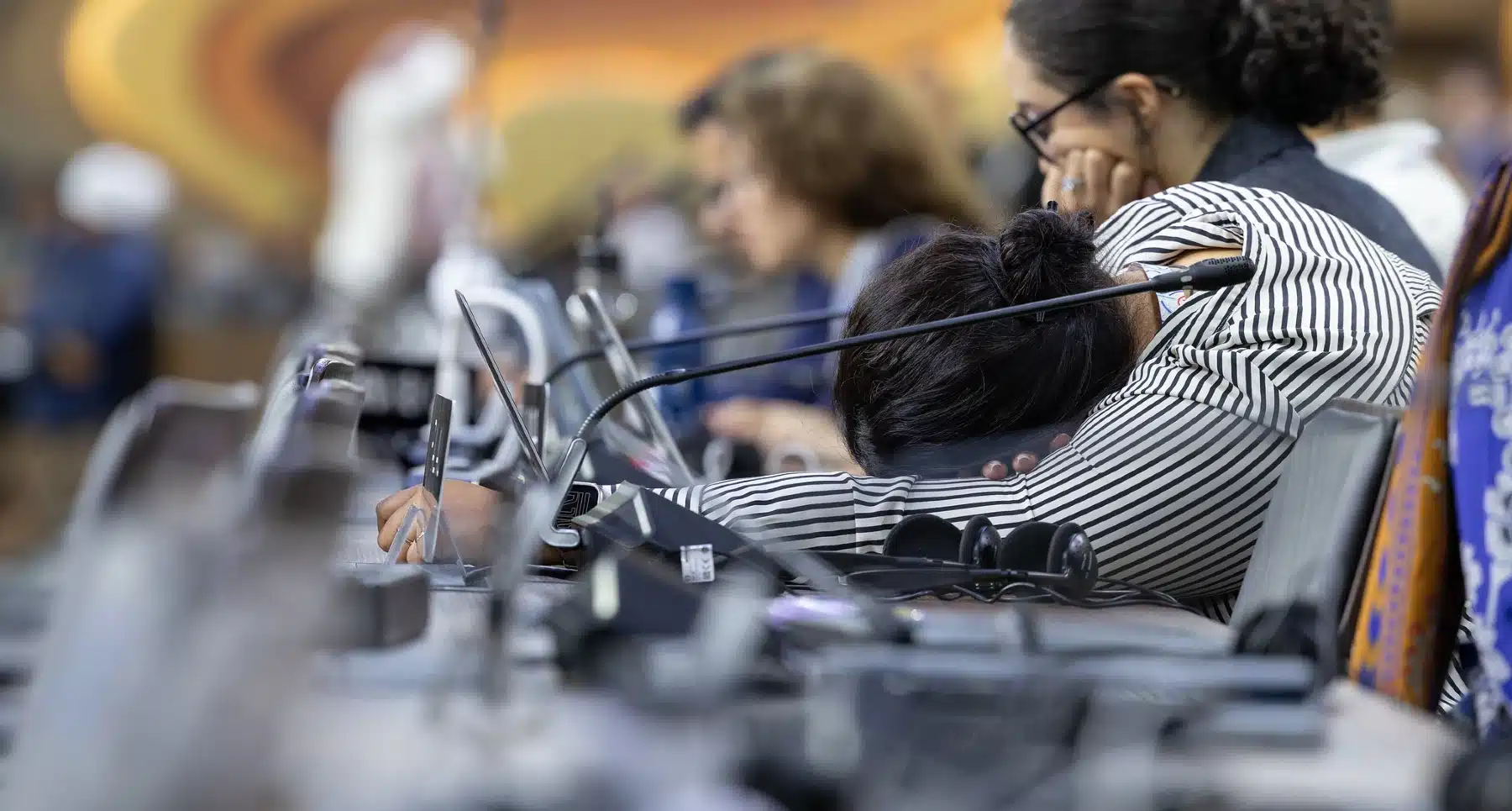
The UN climate summit has ended in deadlock while the US leaves 66 global bodies. Groups of willing countries are taking on more of the work.
COP31 closed in Antalya without an overall agreement, more than 49 hours after it was due to end. Countries rejected the cover decision, the summit’s main political text, which made no mention of fossil fuels. It was the longest climate summit on record, and Turkey’s environment minister, Murat Kurum, gavelled it shut with no deal. “We have been let down on all sides,” the Marshall Islands delegation said.
A year earlier, COP30 in Belém ended without a commitment to phase out fossil fuels. The last summit to fail outright was Copenhagen in 2009. Meanwhile the US, the world’s largest economy, sent no official delegation to Antalya.
Together, the US retreat and the deadlock put one question to every body that runs on consensus: is multilateralism dying, or is it changing shape?
Washington is leaving dozens of global bodies
President Donald Trump signed a memorandum in January that orders the US out of 66 global bodies. Of those, 31 are UN entities. The list includes the UN climate convention and the Intergovernmental Panel on Climate Change. The exit takes effect a year after formal notice. At that point the US will be the only country outside the treaty.
The White House said the bodies work “contrary to U.S. national interests, security, economic prosperity, or sovereignty”. It also said they “advance globalist agendas”. The administration had already moved to leave the World Health Organization, UNESCO and the UN Human Rights Council. Daniel Forti, head of UN affairs at the International Crisis Group, summed up the approach as “my way or the highway.”
During the summit, White House spokeswoman Taylor Rogers said: “The United States is focused on common sense, not climate nonsense.” Still, the America Is All In coalition brought about 120 US delegates to Antalya. They included California Governor Gavin Newsom and Minnesota Governor Tim Walz. “There is no substitute for national leadership,” Newsom said.
The UN is cutting staff as dues go unpaid
The UN’s own finances are shrinking too. Secretary-General António Guterres proposed a 2026 budget of $3.24bn, 15.1% below 2025. Posts would fall from 13,809 to 11,594, a cut of 18.8%. By the end of September 2025, only 136 of 193 member states had paid their dues in full. The US, China and Russia were among those still to pay. Guterres said late payments meant “a race to bankruptcy”.
The US and China take opposite views of the UN
China has taken the opposite line to Washington. Its Global Governance Initiative, published in September 2025, calls multilateralism “the core concept of the existing international system”. It says the UN’s role “must be enhanced, not weakened”. It also says “Practice of unilateralism must be rejected.”
Inside the climate talks, the split ran between oil producers and the countries that want to leave fossil fuels behind. More than 130 countries wanted to restate the transition language agreed at COP28. Mohammad Ayoub, Saudi Arabia’s climate negotiator, defended his side: “We believe that climate change requires all solutions on the table.”
Europe defends the system as aid budgets shrink
The EU and the UK were among those that rejected the Antalya text. Darragh O’Brien, Ireland’s climate minister, spoke for the EU. “This COP, I believe, was hijacked by some oil states,” he said. Kate Hughes, the UK’s climate negotiator, said: “We are profoundly disappointed by the substance of the cover decision.”
Andy Burnham, the UK Prime Minister, was the only G7 leader expected to address the summit. In remarks released before his speech, he said: “The consensus we once enjoyed on science and climate action has broken down.” Foreign Secretary Ed Miliband told a COP31 roundtable that “the answer to this massive challenge is around multilateralism, working together”. The EU’s climate commissioner, Wopke Hoekstra, said that “the EU, as biggest global donor, has and will continue to stand by its commitments.”
The EU and the UK also finalised talks on 20 November to link their carbon markets from January 2028, subject to ratification. At the same time, the UK is cutting aid from about 0.5% of national income to 0.3% by 2027 to pay for defence. Aid from the OECD’s donor members, the US among them, fell 23.1% in real terms in 2025. The OECD calls it the largest annual drop on record.
Consensus gives every country a veto
Al Gore, the former US vice president, called it outrageous “that a handful of petrostates have veto power over any mention of fossil fuels”. He added: “It has been clear for years that the COP process is in need of significant reform.”
Chris Bowen, Australia’s climate and energy minister, led the negotiations in Antalya. He traced the deadlock to the rules. “The fundamental root of the problem is that when COP was created, for reasons I understand, it was made consensus only,” he said. Yet, as he pointed out, “you also need consensus to change consensus”.
Simon Stiell, the UN climate chief, defended the model in his closing speech. “This process belongs to 194 Parties. Consensus works best from the ground up,” he said. Even so, he accepted “there is also scope to improve, modernise, and reform.” In 2024, more than 20 experts wrote that “the COP is no longer fit for purpose”. They included Ban Ki-moon, Mary Robinson and Christiana Figueres.
Coalitions of willing countries are growing
In April, 57 countries met in Santa Marta, Colombia, for the first conference on moving away from fossil fuels. The Dutch government says they account for roughly 30% of global energy demand. “We decided that the transition away from fossil fuels could no longer remain a slogan,” said Irene Vélez Torres, Colombia’s environment minister. Ireland and Tuvalu will host a second meeting in early 2027.
At Antalya, around 90 countries backed a goal for electricity to supply 35% of final energy by 2035. Meanwhile 35 countries signed a pledge to curb SF6, the most potent greenhouse gas. Another 24 endorsed a compact to cut the energy that buildings use per square metre by at least a quarter by 2035. Frank Jotzo, professor of environmental and climate change economics at the Australian National University, said “plurilateral processes are growing”.
Harj Narulla, a lawyer who advised the Solomon Islands at COP31, said small island states had another option. In his words, “they’ll certainly consider turning to the ICJ and other international courts”. In July 2025, the International Court of Justice issued an advisory opinion that states have a binding obligation to combat climate change.
Consensus bodies shrink as clubs grow
On the evidence so far, the consensus system is losing members and money while voluntary coalitions gain signatories. Clubs can move faster, although they bind only the countries that join. So the question in the headline stays open.
COP32 will show whether countries are ready to open talks on the consensus rule. The second Santa Marta conference will show whether the clubs can set dates for leaving fossil fuels. And UN accounts in 2027 will show whether member states still pay for the system they share.
Subscribe
Sign-up to receive our newsletter