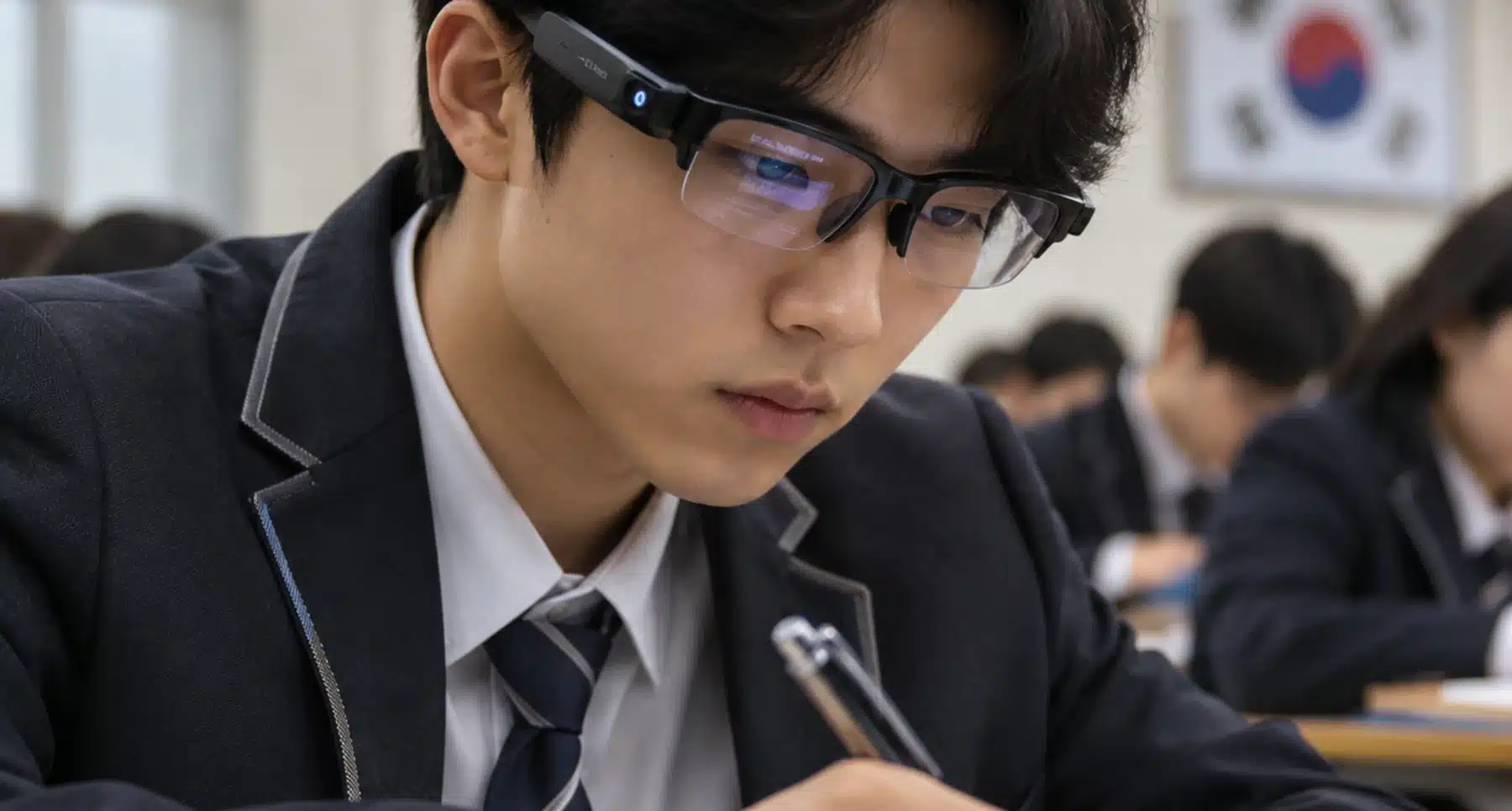
South Korea will inspect every pair of glasses at this week’s university entrance exam, after a top scorer admitted AI cheating. Universities and exam boards from Taipei to Britain face the same problem.
South Korea’s government will deploy about 75,000 proctors to stop AI cheating at the College Scholastic Ability Test, its university entrance exam. Another 8,400 staff will join them across 1,312 test sites. About 1,800 of them will do nothing but check for smart devices. Candidates who wear glasses must put them on the desk before the first session, and proctors will check them again before each one.
Han Won-seok, 34, prompted the crackdown. He topped this year’s national certified tax accountant exam. On 15 November he admitted on YouTube that he had cheated. He said he photographed questions with a miniature camera, sent them to an AI tool and checked the answers on a smartphone. The Human Resources Development Service of Korea, which runs that exam, said it would file a criminal complaint.
The prime minister set out the new checks on 17 November, two days before the exam. Proctors will cover shirt buttons with stickers, inspect collars and sleeves, and keep bags in the hallway. Phones and other devices must be switched off and handed in before the first session. Under rules the education ministry published on 9 November, anyone caught wearing AI glasses loses that result and next year’s sitting. The government also plans to extend the maximum exam ban for cheating from one year to 10.
Korea caught its first glasses cheats this year
Those rules respond to cases that only began in 2026. In May, proctors at two sittings of the TOEIC English test each spotted a candidate who appeared to be wearing AI glasses. After a review confirmed the cheating, the organisers cancelled both scores and barred the pair for four years. In June, National Taiwan University disqualified a medical school applicant for allegedly using AI glasses in an entrance exam. In October, three students in Seoul were caught using smart glasses in university tests.
UK universities recorded a threefold rise
Where exams have counted AI cheating, the numbers climb fast. Proven cases at UK universities rose from 1.6 per 1,000 students in 2022-23 to 5.1 in 2023-24, or almost 7,000 cases. Those figures come from Freedom of Information replies by 131 universities, gathered by the Guardian. Universities projected about 7.5 per 1,000 for 2024-25, while traditional plagiarism fell. Still, more than a quarter of them didn’t record AI misuse as a separate category, so the true figure is likely higher.
China switches off the tools during its exam
During the 2025 gaokao, sat by about 13.4 million students, Alibaba’s Qwen, Tencent’s Yuanbao and Moonshot’s Kimi switched off photo recognition in exam hours. Chinese AI platforms applied the same controls for the June 2026 exam. Gaokao sites are also installing security gates to detect smart glasses.
Choi Kyo-jin, the education minister, told lawmakers that Seoul could cope with the devices now on sale. “For smart glasses already on the market, we can handle them well enough,” he said. However, he added that the ministry probably couldn’t screen out modified devices perfectly.
Thursday’s exam will show whether 75,000 proctors can catch wearable AI at national scale. The number of cases found across 1,312 sites is the first measure. The second is whether British universities start to count AI misuse consistently, so that the trend becomes measurable.
Subscribe
Sign-up to receive our newsletter