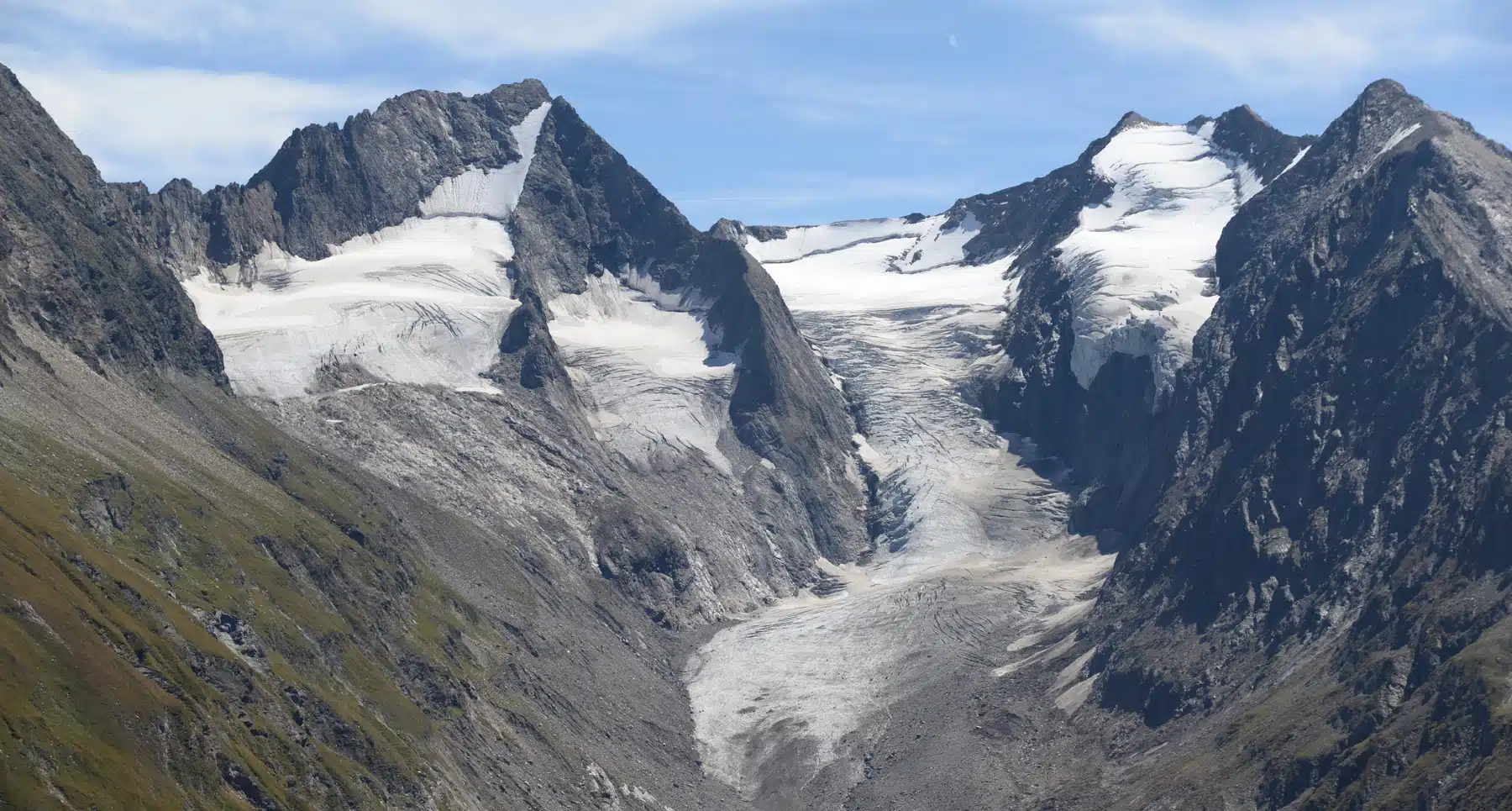
Earth’s ice has moved outside the range it held for 11,700 years, scientists say. Alpine glaciers show what that loss means for rivers, mountain villages and sea levels.
Earth’s ice, snow and permafrost have moved beyond a “safe operating space”, a new study in Science finds. More than 30 scientists took part, led by Dr Bo Su of the Stockholm Resilience Centre and Beijing Normal University. They assessed land ice, sea ice, snow cover and permafrost against the stable climate of the past 11,700 years. “The cryosphere has already exceeded its planetary safe operating space,” Su said.
Switzerland’s glaciers lost more than 5% of their ice in 2026, the GLAMOS monitoring network found. That takes the loss over five years to almost a fifth. Worldwide, glaciers shed about 5% of their volume between 2000 and 2023, a global assessment in Nature found. Central Europe lost 39%. Losses from 2012 to 2023 ran 36% higher than in the previous 12 years.
The Schwarzmilzferner, on the Tyrolean side of the Allgäu Alps, no longer counts as a glacier, researchers say. They have monitored it for 26 years. After this year’s hot summer, it lost about half its volume and its ice stopped moving. Glaciologist Christoph Mayer of the Bavarian Academy of Sciences thinks the Eastern Alps could be glacier-free between 2060 and 2070.
Summer river flows depend on the ice
The Alps feed the Danube, Po, Rhine and Rhône, which draw partly on glacier melt in summer. Runoff from glaciated Alpine areas could fall by nearly 45% by 2100, the UN World Water Development Report 2025 estimates. Total river discharge from those areas could drop by 35% from its 2006 level.
That water supports farming, hydropower, tourism and wildlife, the report says. Worldwide, 1.1 billion people live in mountains, and another 2 billion downstream rely on them for freshwater. Swiss hydropower is less exposed, however. Glacier melt supplies only about 4% of its output, a 2018 study funded by the Swiss National Science Foundation found.
Thawing ground makes mountains less stable
Part of the Birch Glacier in the Swiss canton of Valais collapsed on 28 May 2025, burying most of Blatten. Officials had evacuated the village’s 300 or so residents nine days earlier, and one man went missing. Rockfalls had piled about 3 million cubic metres of debris onto the glacier before it gave way.
Glaciologist Christophe Lambiel linked those rockfalls to thawing permafrost. He said it had warmed by at least 1C in 10 to 15 years. The UN water report expects more avalanches, rockfalls, landslides and floods from glacial lakes as mountains warm.
Melting ice raises seas far from the mountains
Glacier melt added 18mm to global sea level between 2000 and 2023, the same Nature assessment found. Meanwhile, global mean sea level is at its highest since satellite records began in 1993, the World Meteorological Organization reported.
The Science study warns that polar, high-mountain, coastal and low-lying communities face the greatest risks. Martin Sommerkorn, a co-author and head of conservation at WWF’s Global Arctic Programme, wants faster action. “Policymakers must increase their speed and ambition to return global temperatures to safe levels as soon as possible,” he said.
Scientists want ice counted as a planetary boundary
The authors want Earth’s ice added to the planetary boundaries, a framework that tracks nine Earth systems. Seven of those nine are already breached, the Planetary Health Check found in September. The team also wants precautionary targets for black carbon, or soot, as well as greenhouse gases. In addition, it calls for limits on local damage from industry and infrastructure.
Downstream, the loss of Alpine glaciers means less reliable summer rivers, less stable slopes and higher seas. How fast it goes depends on emissions decisions still open at COP31, which closes in Antalya on 20 November. Next summer will give an early reading: Mayer expects the Schwarzmilzferner to have disappeared completely by the end of it.
Subscribe
Sign-up to receive our newsletter