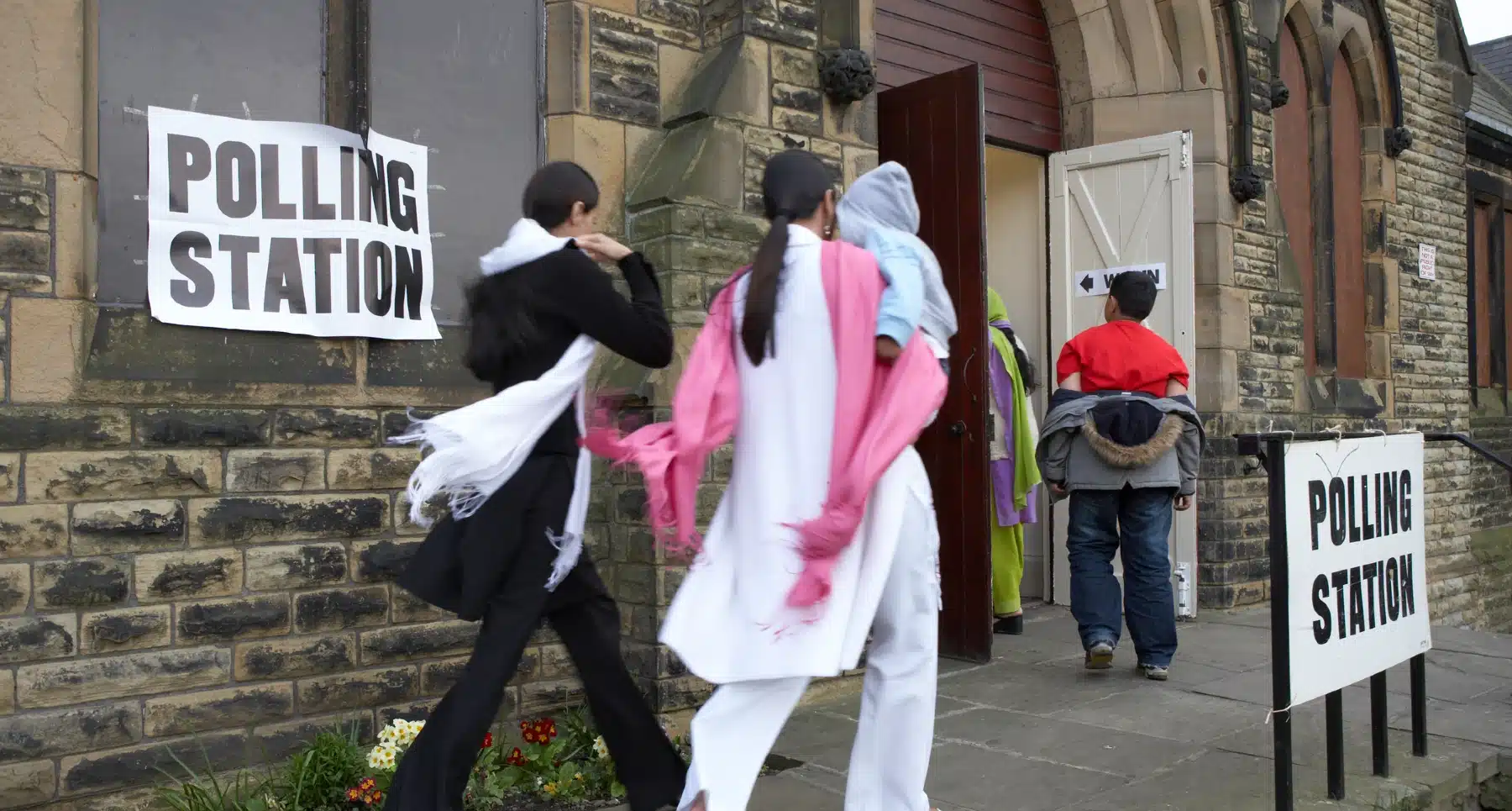
UK Prime Minister Andy Burnham has promised that Labour will fight the next election on changing Britain’s voting system. Italy, the Nordic states and the US show what different rules do to stability, fairness and power.
Andy Burnham, the UK prime minister, told Labour’s conference in Liverpool on 29 September that he’ll set up a national commission on electoral reform. Every party will be invited, and the commission will report before the next general election. He said Labour would contest that election “with a manifesto commitment to change the electoral system”.
In 2024, Labour won 411 of 650 seats, or 63%, on 33.7% of the vote, according to Commons Library figures. Reform UK took 14.3% and five seats. Turnout fell to 59.7%, from 67.3% in 2019.
Burnham framed a new voting system as a fix for churn at the top. “It is always in my mind that I’m the seventh Prime Minister in ten years,” he said. He warned against opening “the door of Number 10 to a divisive government on less than 30% of the vote”. On 27 to 28 September, YouGov put Reform on 25%, Labour on 24% and the Conservatives on 19%. The Lib Dems and Greens were also in double figures.
A YouGov seat projection published on 24 September gave Labour 241 seats, the Conservatives 130 and Reform 123, with no majority. Under first-past-the-post, small shifts in a five-way race can move large numbers of seats. Other democracies have already made the trade Burnham’s commission must weigh, between seats that match votes and governments that form fast and last.
Italy’s record government
On 3 September, Giorgia Meloni’s government became Italy’s longest-serving since the second world war, at 1,413 days. It passed the record Silvio Berlusconi set between 2001 and 2005. Italy has had 68 governments in 80 years as a republic, and the average has lasted about 431 days.
From 1946 to 1993, Italy elected its parliament by list-based proportional representation. Meloni won in 2022 under the Rosatellum, a 2017 law that fills about 37% of Chamber seats in single-member constituencies. Her centre-right alliance took 43.8% of the vote and 237 of 400 seats, about 59%, Commons Library analysis shows. Italian fact-checkers at Pagella Politica credit electoral reforms since the 1990s, and stronger leaders, for longer-lived governments.
Meloni’s coalition is now taking Italy to a fully proportional system with a winner’s bonus. The new law scraps the constituency seats and guarantees a majority to any alliance that wins more than 42% of the vote. The Senate passed it by 113 votes to 71 on 15 September. A final secret ballot in the Chamber is expected on 7 or 8 October. Matteo Renzi, who leads Italia Viva, said the coalition was acting because “there is a risk you will lose the next election”.
Long talks, then durable government
Sweden voted on 13 September, and the Social Democrats came first with 28% and 99 seats. The centre-left parties hold 176 of 349 seats against 173 for the right, official results show. Turnout was 84.9%. On 28 September, Magdalena Andersson said there was “currently no possibility” of her forming a government. Two days later, Speaker Andreas Norlén was still weighing the next step, with nobody holding a mandate.
In Denmark, Mette Frederiksen needed about ten weeks after a snap election on 24 March to form a four-party minority government. By early May the talks had become the longest in Danish history. Sweden took more than four months to approve a prime minister after its 2018 election.
Norway’s parliament can’t be dissolved between elections, so governments must work with the chamber voters chose. A 2024 study by Make Votes Matter, which campaigns for proportional representation, covered 17 democracies from 1974 to 2023. It found that “41% of PR post-election cabinets make it to full term, compared to just 18% of those in majoritarian countries”. The same study found that PR countries take longer to form governments.
America’s fight over district lines
In the US, the run-up to the 3 November midterms has turned on who draws the lines. Texas signed a map in August 2025 designed to gain five Republican seats. California voters replied in November with Proposition 50, aimed at five Republican-held seats.
AP estimated in June that Republicans could net about 10 seats if the new maps worked as drawn. On 10 September, the Cook Political Report put the likeliest gain at around four. The Supreme Court then blocked Missouri’s new map for a third time on 25 September.
The same court ruled 6 to 3 in Louisiana v. Callais on 29 April that Louisiana’s second majority-Black district was an unconstitutional racial gerrymander. Louisiana, Alabama and Tennessee have since each redrawn to remove a majority-Black or Democratic-held seat.
The Fair Representation Act, reintroduced by Democrats Don Beyer and Jamie Raskin in July 2025, would elect the House from multi-member districts. Voters would rank candidates, and mid-decade redistricting would end. It hasn’t advanced, and 19 states now ban ranked-choice voting. Britain avoids most of this fight because independent boundary commissions draw its constituencies.
Which system is best for democracy?
Arend Lijphart, a political scientist, found that “consensus” democracies, which mostly use PR, outperform majoritarian ones on most measures of democratic quality. In Patterns of Democracy, he reports that their turnout is “more than 7 percentage points higher” on average. Their Gini index of income inequality is “more than 9 points lower”.
Steven Levitsky and Daniel Ziblatt, the Harvard authors of How Democracies Die, see PR as a guard against pressures now visible in the US. Parliamentary systems with PR “should be more likely to avoid ethnonationalist governments”, they wrote in the Journal of Democracy in January 2025. Lee Drutman of the New America think tank wants a PR mandate for the House. “The single-member district is the murder weapon and you’ve got to take away the murder weapon,” he told The UnPopulist in July.
Karl Popper, the philosopher, made the classic case the other way in 1988. Under PR, he argued, “a coalition government becomes inevitable”, and “nobody looks on election day as a Day of Judgment”. Richard Pildes, a constitutional law professor at New York University, set out the American objection in a 2024 paper. A House of “five or six political parties”, he warns, would leave the US “even more fragmented and gridlocked than it is already”.
Tarunabh Khaitan of the London School of Economics and Mike Winterwerp point to the Netherlands. Coalition talks there have run for up to 299 days. They wrote in March that “a vote share of 10 to 20 per cent” can make a polarising party “pivotal in coalition formation”.
Alan Renwick, director of the Constitution Unit at University College London, argues that the process is as important as the answer. “The electoral system is the very heart of our democracy,” he wrote on 1 October. “Any decisions about it need to be taken with the greatest possible care.”
What the commission must decide
A Downing Street spokesperson has already narrowed the field, saying “the Prime Minister believes the constituency link is critical”, according to Byline Times. That points away from pure list systems and towards a mixed model like the one used for the Scottish Parliament.
The Conservatives have refused to take part. “Burnham wants to remove voters’ power to sack their MP,” said Alex Burghart, the shadow Cabinet Office minister. Ellie Chowns, a Green MP, attacked the timetable. “The PM cannot acknowledge the unfairness of a system capable of handing power to a government with a minority of the vote share,” she said. His answer, she argued, is “to let that happen exactly once more before he fixes it”.
In 2011, 67.9% of voters rejected the alternative vote in a referendum. By 2024, the British Social Attitudes survey found 60% support for proportional representation, a record high.
Downing Street hasn’t said whether a referendum would follow the commission, or when it will report before an election due by August 2029. Italy shows how much rests on thresholds, bonuses and the share of seats tied to places. Burnham’s commission will be judged on whether it settles that detail before voters see it in a manifesto.
Subscribe
Sign-up to receive our newsletter